Draft.dev built a strong reputation as the go-to agency for developer-focused content, and for good reason: a network of 300+ vetted engineer-writers, a tight focus on developer tools, and enough case studies to credibly claim results.
Retainers start at roughly $8,000–$9,000 per month, with a three-month minimum commitment. The model is optimized for Series A–C companies that need four or more technical articles per month and have the budget and process overhead to support a full agency engagement.
If you're earlier-stage, more budget-constrained, looking for a different kind of help (DevRel strategy, documentation, visual storytelling, or AI-powered generation), or simply evaluating the market before signing a retainer, there are solid alternatives worth knowing about.
This roundup covers the options that come up most often when developer tool teams are shopping around. They fall into three broad categories: specialist technical content agencies, full-service developer marketing agencies, and AI-native content platforms. Each solves the problem differently.
Specialist Technical Content Agencies
These are agencies whose entire practice centers on creating technical content for developer-facing products. If you're replacing Draft.dev like-for-like (expert-written blog posts, tutorials, and SEO content for a developer audience), these are the closest comparisons.
Hackmamba
Hackmamba is a technical content agency started by William Imoh, a developer who spent years writing documentation and tutorials for SaaS and developer tools before founding the company. The team of 50 writers all have software engineering backgrounds, and the agency works with companies including Replit, Mintlify, OpenRouter, and CodeRabbit.
What sets Hackmamba apart is its emphasis on product context. Their stated philosophy is that technical content breaks when written without full product understanding: a direct diagnosis of the problem many teams have with generalist agencies. Every piece goes through a three-pass review process before delivery.
Their content scope includes SEO-driven technical articles, product and integration pages, documentation, onboarding guides, tutorials, and technical video scripts. For SEO content marketing engagements, pricing typically starts at $6,000 per month, with individual articles running $600–$800 each.
Best for: Teams that want a Draft.dev-style agency with a similar pricing tier and an explicit emphasis on technical depth.
Infrasity
Infrasity is a newer entrant (founded 2023) focused specifically on developer tool and B2B SaaS startups. They combine long-form technical SEO content with video production and Webflow development, which gives them a broader scope than most pure content agencies.
Their service offering is structured around developer personas: use case libraries, SDK examples, onboarding docs, and technical guides built for how developers actually evaluate tools. The Scalekit engagement, where developer-focused technical content drove 8x organic traffic growth over nine months, gives a concrete sense of their approach.
Infrasity doesn't publish pricing, but their Starter Plan covers four technical guides per month plus SEO-backed topic ideation, with seven to ten-day turnarounds.
Best for: Early-stage devtool startups that want a lightweight, structured package with predictable output.
Argot
Argot is a content marketing agency focused exclusively on developer audiences. Their team combines engineers and writers to produce content that reads as developer-to-developer, rather than marketing-to-developer. They specialize in thought leadership pieces, SEO-optimized technical articles, and tutorials with validated, runnable code examples.
Argot is a smaller operation than Draft.dev, which can mean a tighter relationship with senior practitioners on your account. Pricing isn't published publicly.
Best for: Teams where authenticity and code accuracy are the primary quality bar, and who want an agency that stays close to developer culture.
Full-Service Developer Marketing Agencies
These agencies go beyond content production to cover DevRel strategy, demand generation, developer experience (DX), and community building. If your need is broader than "write more blog posts," these are worth considering.
Hoopy
Hoopy is a developer relations and marketing agency founded by Matthew Revell, former Director of Developer Advocacy at Couchbase and the organizer behind DevRelCon. Their playbook covers DevRel strategy, technical content, community engagement, and developer-focused distribution.
The emphasis is on developer adoption as a community and trust problem before it's a marketing problem. If your growth depends on DevRel motions (communities, workshops, ambassador programs, and events) rather than pure content production, Hoopy is one of the most credible options in the market. They're smaller and more selective than Draft.dev, which means stronger fit but less production capacity.
Pricing is custom. No public rates.
Best for: Developer tool companies whose primary growth lever is community and DevRel, not content volume.
EveryDeveloper
EveryDeveloper is Adam Duvander's solo consultancy, and Adam is probably the most cited voice in developer experience (DX) content strategy. His book, Developer Marketing Does Not Exist, is widely referenced in the space. With EveryDeveloper, you get content strategy and production plus a DX audit that scores your developer experience across 13 defined elements.
The value here is strategic depth and genuine domain expertise, not volume. Adam works with a small set of clients directly. No public pricing.
Best for: Teams that want strategic guidance on DX and content from someone with deep domain credibility, not a production engine.
Catchy Agency
Catchy Agency (not to be confused with "catchy writing") has been operating since 2010 and serves Fortune 100 tech clients as well as growing scale-ups. They offer full-service developer marketing: DX audits, content strategy, demand generation, and go-to-market execution. They've built proprietary tooling (Developer Voice AI, Developer Signal Hub) for social listening and positioning research.
The trade-off is that Catchy is more expensive and more oriented toward enterprise engagements. They're not a content-only shop. No public pricing.
Best for: Companies that need a strategy layer plus execution across multiple developer marketing channels, and have the budget for a full-service partner.
AI-Native Content Platforms
This category is a meaningful departure from the agency model. Instead of a team of writers working on your account, you get a platform that generates draft articles grounded in your product documentation, then optionally adds human expert review before publishing. The economics, speed, and volume dynamics are entirely different.
Parallel Content
Parallel Content is an AI-native content platform built specifically for developer tool companies. The core workflow is: connect your documentation and product context, add content ideas, generate drafts in parallel, and optionally request human expert review before publishing.
Where Parallel Content differs from generic AI writing tools is the product context layer. The platform indexes your documentation, website, and any other product files you provide. Every draft is grounded in how your product actually works, not assembled from general training data. That means fewer errors, fewer correction cycles, and content that sounds like it came from someone who actually used your product.
The economics are also fundamentally different from agency retainers. Plans start at $199 per month for 10 articles, scaling to $449 for 25 and $799 for 50. Optional Expert Review (vetted subject-matter experts who proofread for technical accuracy and add a "Reviewed by" badge) is available from $39 per article. For a team publishing four or more posts per month, the per-article cost is an order of magnitude lower than agency rates, and drafts are ready in minutes rather than weeks.
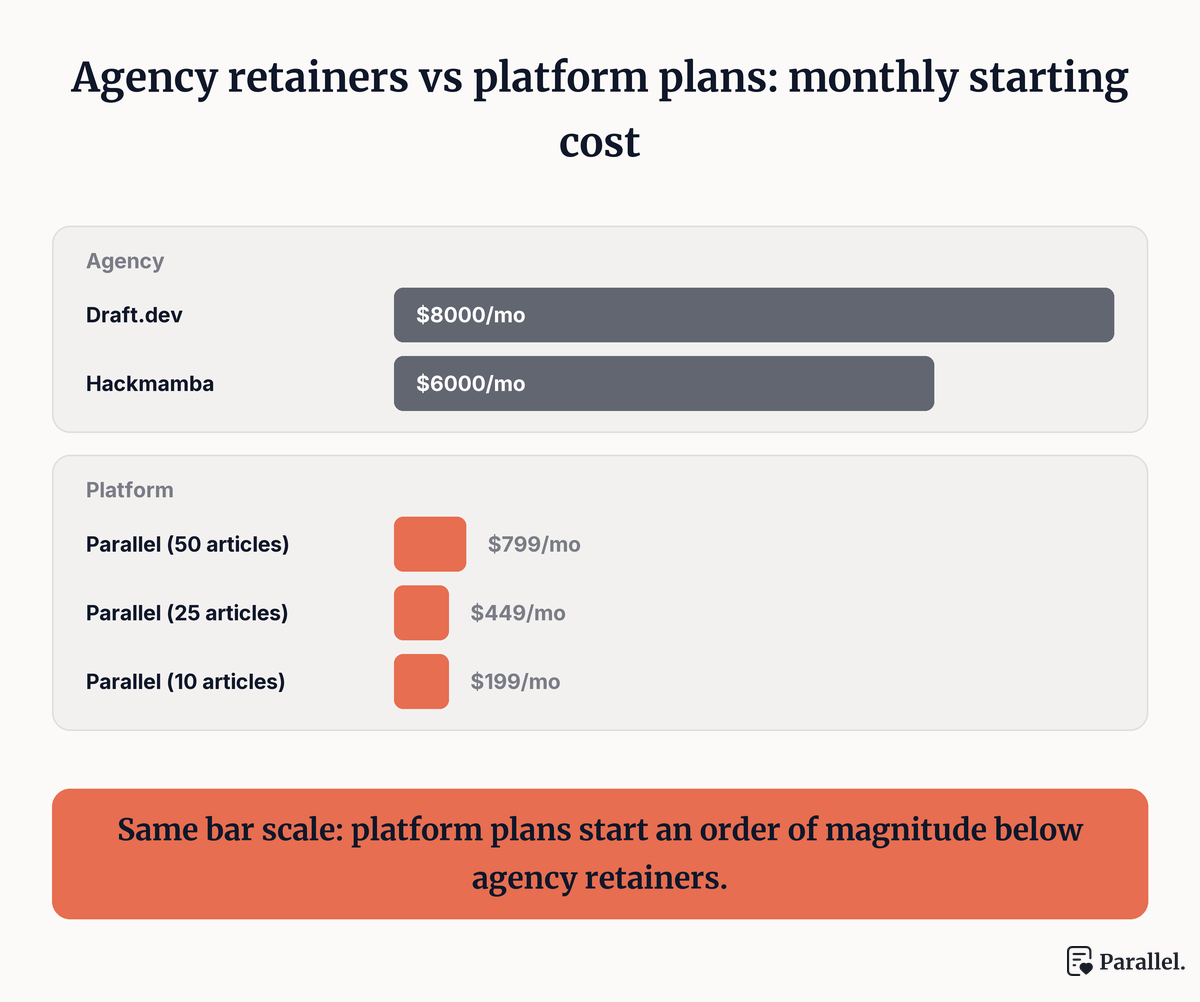
Figure 1: Monthly starting costs across models — agency retainers vs. Parallel Content platform plans.
For teams trying to understand where this fits relative to the agency model, the comparison between Parallel Content and a traditional content agency is worth reading.
Best for: Developer tool companies that need consistent publishing velocity, want content grounded in their actual product docs, and don't want to manage writer relationships or long agency retainers. Especially strong for early-stage and growth-stage teams where per-article cost matters.
How to Choose
The right answer depends on what you're actually trying to solve. A quick diagnostic:
- You need high-quality articles at scale, with engineer-writers, and budget is not a primary constraint. Draft.dev, Hackmamba, or Infrasity are the closest matches. Expect to spend $6,000–$9,000 per month minimum.
- You need DevRel strategy and community-building, not just blog posts. Hoopy or EveryDeveloper, depending on whether you need ongoing execution or strategic guidance.
- You need to understand your developer experience holistically before producing more content. EveryDeveloper's DX audit is a logical starting point.
- You need a full developer marketing program across strategy, content, and demand generation. Catchy or Hoopy for enterprise-scale needs.
- You need to publish consistently at a lower per-article cost, and want your content grounded in your product's actual documentation. An AI-native platform like Parallel Content, with optional human expert review for the articles that need extra confidence.
If you want a structured framework for comparing these options side by side, our guide to evaluating technical content writing services walks through the key criteria step by step.
One last thing worth mentioning: many developer tool content programs work best with a combination. An AI-native platform for consistent, product-grounded content at scale, plus selective use of specialist agency or freelance help for deep investigative pieces, case studies, and content that genuinely benefits from a named human author.
The case for each model isn't binary. The best teams figure out which parts of their content calendar benefit from human-first production and which ones are better handled at platform scale. What's changed in 2026 is that you have real options across the full spectrum. The question isn't just "which agency?" It's "what model fits how my team actually works?"