You're the marketing team. You're also the strategist, the writer, the editor, the scheduler, and the person who posts the tweet. If you're running content for a developer tool with no dedicated team behind you, the challenge is system design: how do you build something repeatable when you're the only person operating it?
The good news is that a team of one can run a genuinely effective content program. But only if you stop trying to do everything and start building a lightweight machine that produces consistent output without heroics. This guide walks through exactly how to do that.
Start by accepting what you can realistically ship
The most common mistake solo content operators make is committing to a cadence they can't sustain. Two posts per week sounds ambitious in month one. By month three, you've burned out, the calendar has slipped, and publishing feels like a source of guilt rather than momentum.
The sustainable publishing rate for a team of one is usually one well-researched piece per week, or even one every two weeks. That's enough to build a content library that compounds over time, and it's a pace you can maintain for months without burning out.
Before you touch a topic list or an editorial calendar, decide on your honest capacity. Block the actual hours on your calendar. If you have four focused hours per week to devote to content, plan accordingly. One solid tutorial every two weeks, shipped consistently, outperforms four rushed posts per month every time.
Build a topic backlog, not a blank calendar
An editorial calendar without a backlog is a commitment to decide what to write the week you need to write it. That's how you end up staring at an empty doc on Thursday afternoon with nothing to say.
A backlog is a running list of ideas, organized before you need them. For a developer tool, the best ideas almost always come from the same sources:
- Support tickets and community questions: These are the questions real developers are already asking. If three people asked the same question last month, it belongs in your backlog.
- Search queries hitting your docs: If developers are landing on your documentation looking for something they can't find, that gap is a post.
- Competitor content: Look at what's ranking well in your category. You don't copy it; you find the angle your product is uniquely positioned to address.
- Your own onboarding friction: Every step where new users get stuck is an activation content opportunity. Write the guide that would have saved them.
Keep the backlog in a simple spreadsheet or a doc. Each row needs a working title, a one-line description of what the reader will learn, and a note on where it fits the developer journey: discovery, evaluation, or activation. Most solo content programs are over-indexed on discovery (concept explainers, broad primers) and under-invested in activation content, the tutorials and guides that help users actually succeed with the product. Audit your backlog early and fix the imbalance.
When the backlog is healthy, deciding what to write next takes five minutes. That's the goal.
Separate "deciding" from "writing" from "publishing"
One of the biggest productivity killers for solo content operators is task-switching. You sit down to write and spend the first hour deciding what to write. You finish a draft and immediately try to edit it. You tweak a post's metadata while you're trying to finalize the structure.
The fix is simple: separate these three phases in time.
- Decide on Mondays. Pick your next topic from the backlog, confirm the format, and write a two-paragraph brief to yourself: who this is for, what they'll be able to do after reading it, and the three to five main points to hit. This takes 15 minutes and eliminates the ambiguity that kills writing momentum later in the week.
- Write in a dedicated block. Your best writing happens when you're not also deciding what to write. Close everything except your brief and your doc. Don't edit as you go. Get to a complete first draft before you read back over it.
- Edit and schedule separately. A day between drafting and editing makes you a dramatically better editor. You catch what you can't see when you're still inside the piece. Use this session to tighten the prose, check every code example or step, and prepare the post for publishing.
This three-phase rhythm is the structural insight behind how effective content teams operate, even when it's a team of one.
Protect technical accuracy above everything else
For developer tool content specifically, a technically wrong post isn't just a missed opportunity. It's actively damaging. Developers remember when a code example doesn't work. They share that experience. A single tutorial with broken steps can undermine trust that took months to build.
As a solo operator, you're both the writer and the technical reviewer, which is harder than it sounds. When you've written something, you fill in gaps automatically from your own knowledge. You don't see what a reader who doesn't have your context will stumble on.
A few practices that help:
- Run every code example fresh, in a clean environment. Don't assume the snippet works because it worked in your development setup. Verify it in isolation.
- Use a pre-publish checklist. Before any post goes live: code tested and working, product version noted, no claims that contradict current documentation, all links verified. This takes five minutes and catches the errors that erode credibility.
- Read it as the reader. After your editing session, read the post one more time from the top, pretending you've never used your product. Where would you be confused? Where does the assumed knowledge gap between you and a new user bite hardest?
Use AI to eliminate the drafting bottleneck
The part of content production that consumes the most time for a solo operator is drafting. Gathering research, structuring the post, writing a coherent first draft from a brief: this is where hours disappear.
AI content tools can dramatically compress this stage, but with an important caveat: generic AI tools don't know your product. If you ask a general-purpose AI to write a tutorial about your developer tool, you'll get something that sounds plausible but gets the details wrong. The feature names are off. The code examples use an API that doesn't match your actual SDK. The result needs more editing than if you'd started from scratch.
The solution is a tool that writes from real product context, not generic training data. Parallel Content indexes your documentation, website, and brand guidelines before generating drafts, so every post it produces reflects how your product actually works. You bring the topic and the intent; the platform handles the research, structure, and technically grounded prose.
For a team of one, this changes the math entirely. Instead of spending eight hours on a single post, you're spending two: one to review and refine the draft, one to edit and publish. That's the difference between publishing twice a month and publishing twice a week, without burning out.
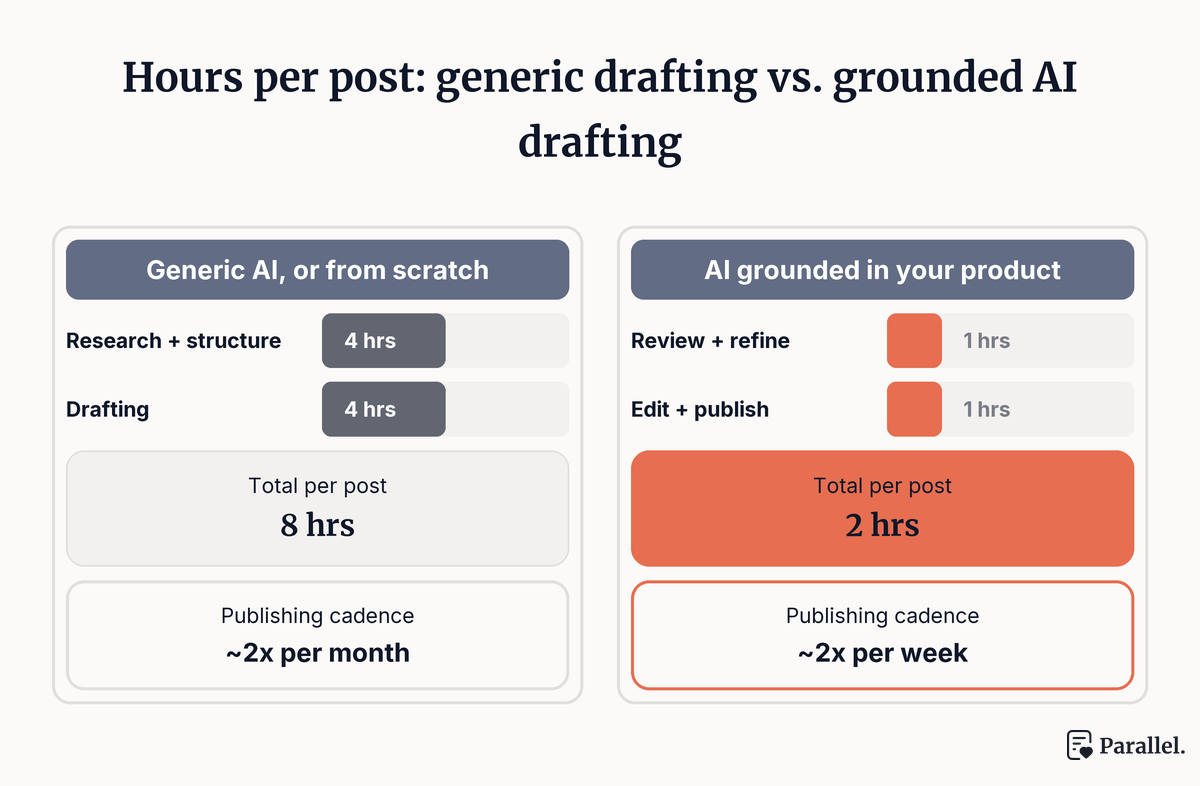
Figure 1: The time math changes when the tool drafts from real product context.
Build a minimal distribution habit
Publishing without distribution is like writing in a private journal. Solo content operators often skip distribution because it feels like a separate job on top of an already full one. The fix is to make distribution a checklist you run at the end of every publish, not a separate initiative you launch someday.
For each post, do these four things:
- Post in one relevant community. Find the Discord server, subreddit, or Hacker News thread where developers who'd care about this topic are already talking. Don't drop a bare link; add a sentence of context. This is contributing to a conversation with a relevant resource.
- Share internally. If you have founders, engineers, or teammates who have any social presence, make it easy for them to share. Write the LinkedIn or X post for them. One pre-written paragraph removes most of the friction.
- Add internal links. Before you publish, make sure the new post links to at least two or three related pages on your site, and that at least one existing page links back to the new post. Developer marketing content compounds through internal linking; orphan pages are invisible to search engines and under-indexed by AI.
- Add it to your newsletter if you have one. Even a small newsletter to existing users is a meaningful distribution channel. Don't wait until you have 10,000 subscribers to use it.
This whole checklist takes 30 minutes per post. Over six months, it compounds into a library that's actually discoverable, not just published.
Track the one metric that tells you if it's working
Solo content operators often track too much or nothing at all. Too much and you spend your week in dashboards instead of writing. Nothing and you have no idea which bets are worth doubling down on.
Pick one primary metric and check it monthly: content-attributed signups. Which posts appeared in sessions before a user signed up? This is the cleanest signal that your content is actually moving the needle, not just generating traffic.
Set up a basic attribution view in your analytics tool. Connect content page visits to your signup flow. Then, once a month, look at which posts are in the attribution path most often. Double down on the formats, topics, and developer journey stages that are producing that signal. Retire (or update) the ones that aren't.
Secondary metrics worth a quick monthly glance: organic search traffic growth (are you building discoverability over time?), time on page (are people actually reading?), and community engagement (are developers responding?).
For a more complete measurement framework, the guide on measuring the ROI of technical content covers the full attribution stack in depth.
The system beats the sprint
A team of one can absolutely run a content program that compounds into real growth. What it requires isn't superhuman output. It's a system that you actually operate: a backlog you trust, a weekly rhythm you protect, a drafting process that doesn't eat your entire week, and a distribution habit you run every time you publish.
The developer tool companies that win on content aren't the ones that published the most posts in a quarter. They're the ones that showed up consistently, wrote things that were genuinely useful to developers, and built a library that earned trust and discoverability over time. That's entirely achievable as a team of one, if you build the right machine.
If you're ready to stop treating every post as a from-scratch effort, try Parallel Content for free. Index your product context once, and start generating technically grounded drafts in minutes. No onboarding calls required.